
Concert Review
The Kid Is Still Here
Fifteen years after Torches became part of the soundtrack to my adolescence, Foster the People opened what Mark Foster told Phoenix would be their final tour. Somewhere between memory, music and whatever comes next, I found the kid who first heard “Pumped Up Kicks” again.
Foster the People · The Good Mourning Sunshine Tour · Arizona Financial Theatre · Phoenix, AZ
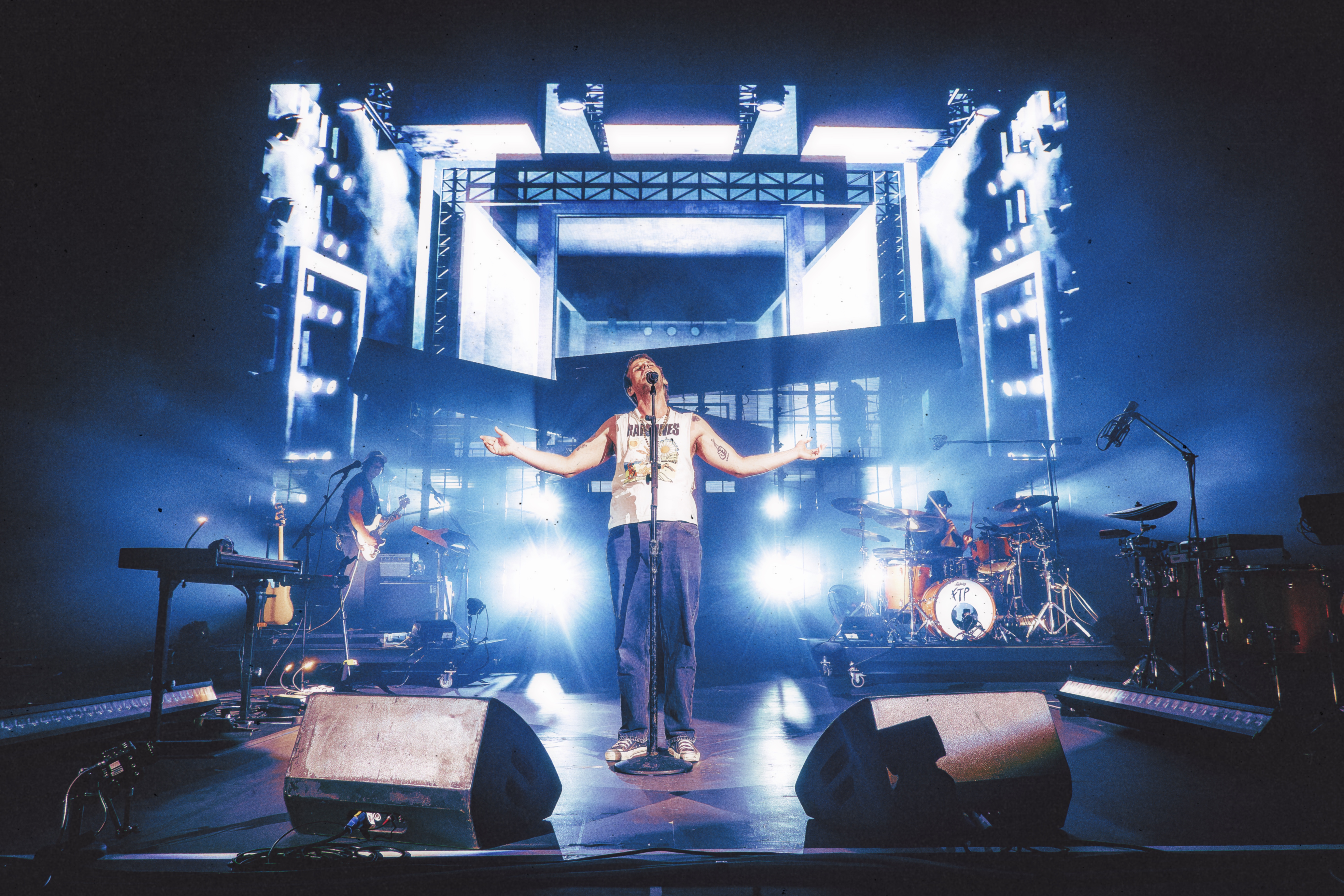
There are certain songs you remember discovering.
Not because you remember where they sat on a chart or what critics said about them. You remember the room. You remember who was sitting next to you. You remember what you were doing seconds before the song entered your life.
I remember exactly where I was when I first heard “Pumped Up Kicks.”
I was in eighth grade, sitting in computer class with my friend Connor Hogan.
And we were doing basically everything except paying attention in class.
We were checking sports scores. Looking at highlights. Bouncing around websites. Talking about whatever middle-school kids talked about. Basically finding every possible excuse not to do whatever assignment was sitting in front of us.
Connor had Best Buy’s website open.
Back then, you could pull up an album and listen to little previews of the songs.
I couldn’t really see what Connor was looking at from where I was sitting.
Then something started playing.
That hook hit.
And I remember physically snapping my head up.
“What is that?”
Connor told me.
“Pumped Up Kicks.”
Foster the People.
That was it.
I went over to his computer and started going through the Torches previews.
One song.
Then another.
Then another.
Who the hell are these people?
Where can I hear more?
And for roughly the next 24 hours, “Pumped Up Kicks” was basically the only song I listened to.
I don’t mean I played it a lot.
I mean repeat.
Again.
Again.
Again.
School.
The bus ride home.
At the computer.
Getting picked up by my grandparents.
The car ride to football practice.
I remember getting to practice early and sitting there staring out at the park with that song still playing.
It became obsessive.
But that is how music has always worked for me.
I don’t just hear it.
I see it.
I LIVE INSIDE THIS ALBUM
I have hyperphantasia, which means the images I create in my head can be unusually vivid.
Put the right music in my ears and my brain starts directing movies.
Characters.
Locations.
Colors.
Camera movements.
Cuts.
Entire scenes.
Some artists trigger that more than others.
Foster the People has always been near the top.
That is why saying Torches is one of my favorite albums doesn’t completely explain my relationship with it.
I live inside this album when I listen to it.
“Pumped Up Kicks” has places in my head.
It has people.
It has sunlight.
It has bikes.
It has school buses.
It has football practice.
It has friends I don’t see anymore.
It has stupid shit we did when we were kids.
It has memories that actually happened mixed together with scenes that never did.
There is an entire sequence I have been directing in my head for years involving my friend Olive, this ridiculous conflict from when we were freshmen, older kids we probably had no business being around, everything eventually exploding into chaos and us running from cops while “Pumped Up Kicks” plays over it.
I have never filmed it.
Nobody else has ever seen it.
But I have.
Hundreds of times.
That is what music can do to me.
A song stops being a song.
It becomes a place.
And Torches became one of the places where a huge part of my childhood lives.
HELL OF A WAY TO START A CONCERT
Before any of that nostalgia could really settle in, Mark Foster walked onto the stage at Arizona Financial Theatre and essentially dropped a bomb on everybody.
He told Phoenix that this would be Foster the People’s final tour.
Excuse me?
Hell of a way to start a concert.
You could almost feel the collective “what the fuck?” move through the room.
I had already walked into the night knowing it was going to be emotional.
Foster the People is not simply another band I like.
Torches is one of those records that became attached to a version of my life.
And now, apparently, I might be watching the beginning of the final Foster the People tour.
That gave everything that followed considerably more weight.
HELENA BEAT
There is one music video from that era that means something completely different to me now.
“Helena Beat.”
Adult Mark Foster gets thrown into this bizarre post-apocalyptic world populated by kids. He is captured, strapped into this strange machine and eventually transformed back into a child.
When I was thirteen, it was just a weird, awesome Foster the People video.
Fifteen years later?
I understand that image completely differently.
Because that is what this music does to me.
I am an adult now.
I work.
I teach.
I am in graduate school.
I have bills.
I have family responsibilities.
I am building businesses.
I am building Cavale Live.
I spend an enormous amount of my life thinking about tomorrow.
Put Torches on?
I’m gone.
For a little while, somebody turns the machine back on.
I’m that kid again.
Not because I want to undo adulthood.
Not because childhood was perfect.
It wasn’t.
And not because growing up is some tragedy.
It is because there is a piece of that kid that adulthood never managed to kill.
The kid who can hear a bass line and see an entire movie.
The kid who can listen to one song for an entire day because nothing else in the world sounds as interesting.
The kid who can become completely obsessed with something simply because it makes him feel.
He is still here.
And walking into Arizona Financial Theatre, I don’t think I realized how much I needed to see him again.
THE GUY WHO KEPT GOING
I have also started looking at Mark Foster differently as I have gotten older.
Before Foster the People existed, Foster was a kid from Ohio who moved to Los Angeles as a young man to pursue music.
He spent years trying to make it work. Before the band broke through, he wrote music for commercials while continuing to pursue his own work.
Then “Pumped Up Kicks” happened.
Torches happened.
Foster the People happened.
Everything changed.
But success did not freeze Foster the People in 2011.
The lineup changed.
Cubbie Fink eventually left.
Mark Pontius eventually left.
The industry changed.
Music changed.
Culture changed.
The kids who discovered Torches grew up.
And Mark Foster kept going.
Today, he is the remaining founding member of Foster the People.
I don’t know Mark.
I don’t know what carrying Foster the People forward has actually felt like to him.
I don’t know whether it has ever felt lonely.
I don’t know whether it has been exhausting, liberating, exciting or none of those things.
Maybe I am projecting some of myself onto somebody whose private experience I know very little about.
But I know what I see when I look at the story from the outside.
He kept going.
And I respect the hell out of that.
Because getting successful is one thing.
What happens afterward?
How do you remain hungry when you are no longer the broke kid trying to get through the door?
How do you stay curious?
How do you keep finding something worth saying?
How do you make something new without simply trying to recreate the thing everybody loved the first time?
How do you carry a creative identity for fifteen years while everything around it changes?
I don’t know Mark Foster’s answers.
Watching him made me want to ask the questions.
WHAT SURVIVED?
This year is my ten-year high school reunion.
That has made me think a lot about the person I thought I was going to become and the person I actually became.
Ten years is enough time for those two people to finally meet.
People grow up.
They get married.
They have children.
They build careers.
They discover that what they wanted at eighteen is not necessarily what they want approaching 30.
There is nothing wrong with any of that.
Growing up is supposed to change us.
But I have found myself asking something different.
What didn’t change?
When I was younger, creativity felt communal.
Everybody had some crazy idea.
Everybody was making something.
Everybody was going to do something.
Then life happens.
People discover other priorities.
Dreams change.
Again, there is nothing wrong with that.
But I look at myself ten years later and realize:
I actually did it.
I said I wanted a creative life.
I am still building one.
I am photographing concerts.
I am writing.
I am making things.
I am pursuing a master’s degree in learning design and technology.
I am teaching.
I am building businesses.
I am still looking at the world and imagining what I could turn it into.
And there are moments where that can be lonely.
That is another reason I found myself watching Mark Foster differently.
Not because I know he feels the same way.
I don’t.
But there is something about looking at the last founding member of a band you discovered as a kid and realizing that fifteen years later, he is still making the thing.
So am I.
Different scale.
Completely different lives.
But there is a little piece of stubbornness there that I recognize.
Keep going.
FIVE FEET
There is another part of this night that would have bothered an earlier version of me considerably more.
I applied for a photo credential.
I didn’t get one.
Six photographers did.
There was a time when that could have gotten inside my head.
Why them?
Why not me?
What do they have that I don’t?
Then I got to the front.
I looked at the photographers in the pit.
And realized:
They are about five feet in front of me.
That’s it.
Five feet.
A credential did not make them photographers any more than not having one made me less of one.
They had an advantage.
Unobstructed pit access for the opening songs.
I had another advantage.
I could stay.
So I did.
I photographed Foster the People from the front for the entire night.
I watched.
I listened.
And eventually I stopped thinking about the imaginary hierarchy represented by a barricade and started appreciating what was actually happening.
I was photographing one of my favorite bands.
Front row.
Fifteen years after discovering them.
And somewhere along the way, I stopped covering the concert and just started experiencing it.
SOMEBODY TURNED THE MACHINE BACK ON
Earlier that day, I was exhausted.
Not “I would like a nap” exhausted.
I mean genuinely considering not going.
And this is Foster the People we are talking about.
That is how tired I was.
Life has been a lot.
Work.
Graduate school.
Family.
Businesses.
Cavale Live.
Everything.
Then the show started.
And all of it disappeared.
For however long Foster the People was onstage, I wasn’t thinking about tomorrow.
I wasn’t thinking about emails.
I wasn’t thinking about school.
I wasn’t thinking about money.
I wasn’t thinking about whether I had gotten a photo credential.
I was just there.
The machine was on.
And I was thirteen again.
That is why the concert felt so impossibly fast.
Normally, I can feel the architecture of a show.
This one just moved.
Song.
Memory.
Photograph.
Another song.
Another memory.
Another photograph.
I was having too much fun to notice time passing.
Then suddenly we were approaching the end.
And Mark Foster started talking.
“RIGHT HERE, THIS IS REAL.”
I happened to already be recording.
I did not know what Foster was about to say.
I did not know I was about to capture the moment that would ultimately explain the entire night to me.
He started by talking about how medicinal music can be — about its ability to reach places other things sometimes cannot.
Then he said there was “something really spiritual about what we’re doing here together.”
That immediately got me.
Because that is exactly what music has always been for me.
Not background noise.
Not content.
Not something I put on because silence is uncomfortable.
Medicine.
But then Foster started going somewhere considerably more vulnerable.
He talked about how, at some point, he had “kind of stopped putting my voice out there.”
He talked about fear.
About there being “a lot of fear” for artists to speak — for anybody to speak.
He talked about how difficult it had become to figure out where the truth actually was underneath all the narratives and stories competing for our attention.
Then his tone shifted.
“I wanna talk again.”
And then:
“I wanna connect with you guys again.”
That was when something really started happening to me.
Because it wasn’t only what Mark Foster was saying.
It was how he was trying to say it.
I watched his hands.
The way he gestured while searching for the next thought.
The pauses between sentences.
The changes in his voice.
The way he looked into different sections of the crowd as if he wasn’t speaking at thousands of people so much as trying to communicate with them.
The way his face changed when the words became harder.
And something about it felt incredibly familiar.
Not in some bullshit “yeah, man, we’re all on the same cosmic frequency” kind of way.
Something much more specific.
I recognized the way he was trying to communicate.
I recognized what it looked like when somebody has so much happening internally that translating it outward doesn’t always come out in a perfectly polished line.
I see that in myself.
I see it in some of my students.
I see it in artists.
I see it in people who have spent portions of their lives feeling slightly outside whatever everybody else seems to understand naturally.
The outcasts.
The people who feel intensely.
The people who become completely consumed by the things they care about.
The people who sometimes need a little longer to find the words because there is too much happening behind them.
Watching Mark Foster standing there, I had this overwhelming feeling:
Holy shit. I understand what you’re trying to say.
Not intellectually.
I felt it.
And there was almost a sense of relief in that.
Because actually feeling understood is rare.
Actually recognizing some piece of the way your own mind works in the way another person is struggling to articulate theirs is even rarer.
Foster kept going.
He talked about watching people lose their minds.
Watching friends lose their minds.
Losing friends to addiction.
He talked about the psychological pressure of the internet, information, misinformation and what he called the “brain rot that we’re all affected by.”
Then he looked out at us and said:
“Right here, like, this is real. And I’m here with you.”
That line fucking got me.
Because he was right.
Whatever existed outside Arizona Financial Theatre could wait.
The feeds.
The comments.
The algorithms.
The noise.
Thousands of us were standing inside the same physical room.
He was there.
We were there.
This was real.
Then he told the audience something else.
That we were special.
Even if we didn’t feel that way right now.
And then Foster’s words carried him into something even more personal.
“This has been one of the hardest years of my life.”
He admitted that he hadn’t known whether he would be able to do the tour.
He had anticipated having a new album finished before it began.
Then:
“It’s hard to write songs if your heart’s not whole.”
I watched his face.
He smiled.
He laughed at moments.
But his eyes were changing.
I don’t mean tears were streaming down his face.
They weren’t.
It was subtler.
There was that thin layer of water beginning to form across his eyes — that moment immediately before emotion physically gives itself away.
And watching it triggered something in me.
My own eyes started getting heavy.
My throat tightened.
I could feel myself getting choked up.
And that surprised the hell out of me.
I’ve been emotional listening to music before.
Of course I have.
But this was different.
I wasn’t getting emotional because he played my favorite song.
He hadn’t even played it yet.
I was getting emotional because his emotion was triggering mine.
I felt understood.
Not even Ye has done that to me.
And everybody who knows me knows what his music means to me.
But this wasn’t about ranking artists.
It wasn’t about celebrity.
It wasn’t even really fandom anymore.
It was recognition.
For a few minutes, I felt like I was listening to somebody trying to communicate from a place I understood almost instinctively.
Then Foster said something that brought the entire exchange full circle:
“This is healing me too, being here with you.”
There it was.
I had spent fifteen years using something Mark Foster created as medicine without him ever knowing I existed.
“Pumped Up Kicks” had been there when I was thirteen.
Torches had stored pieces of my childhood.
His music had given my imagination places to go.
And now I was standing feet away from the person who made it while he was telling us that being there with us was healing him too.
Maybe that is what the exchange actually is.
Maybe the artist creates something because they need somewhere to put what they are feeling.
Then they release it.
Someone they will never meet finds it.
That person carries it through fifteen years of their own life.
And eventually, somehow, thousands of those people end up standing in the same room and hand some of that feeling back.
Then Mark Foster told us he loved us.
And after all of that — after talking about silence, fear, connection, addiction, brokenness and healing — came the song that started this entire fucking story.
THIS IS FOR YOU, ANTHONY
“Pumped Up Kicks.”
Of course it was.
The song Connor played on a computer in middle school.
The song I listened to on the bus.
The song I played riding with my grandparents.
The song I listened to before football practice.
The song that has carried hundreds of imaginary scenes through my head for fifteen years.
And now it wasn’t merely nostalgia hitting me.
I had already been emotionally cracked open.
Then that bass line arrived.
Recognition.
Relief.
Memory.
Euphoria.
Pure fucking ecstasy.
I instinctively pulled the camera back.
For once, I wasn’t filming Mark Foster.
I filmed myself.
And I said:
“This is for you, Anthony.”
“This is for eighth-grade you.”
I didn’t write that line afterward.
I didn’t invent it while trying to make this article emotional.
That is what I said in the moment.
Because that is exactly what it felt like.
Thirteen-year-old Anthony had no idea where his life was going.
He didn’t know he would become a photographer.
He didn’t know he would start his own music publication.
He didn’t know he would teach.
He didn’t know he would go to graduate school.
He didn’t know that fifteen years later he would be standing feet away from Mark Foster with a camera in his hands.
He just knew he had found a song he couldn’t stop playing.
And fifteen years later, I got to give the moment back to him.
I EARNED THIS. I STILL CAN’T BELIEVE I GET TO DO IT.
There is a contradiction I have learned to accept lately.
If somebody told me I didn’t deserve the opportunities I have had, I could argue with them for an hour.
I know how hard I have worked.
I know what I have sacrificed.
I know what I have built.
I know what I have earned.
But then I will actually be standing inside one of these moments and another part of me takes over:
How the hell do I get to do this?
Both things can be true.
I earned this.
And I am unbelievably grateful that I get to experience it.
That is not insecurity.
That is not false humility.
It is wonder.
And maybe that is the part of myself I am most grateful adulthood did not take.
The ability to still be overwhelmed.
To still hear a song and disappear inside it.
To still see movies in my head.
To still get excited.
To still look at somebody making something sincerely and think:
Holy shit.
This is beautiful.
WHAT MUSIC DOES
I don’t know how else to put this:
Music gets me high.
Not in the casual sense of saying a song gives me energy.
I mean there are combinations of sound, memory and emotion that produce something in me that feels almost chemical.
Euphoria.
A three-minute song can collapse fifteen years into the present.
I am standing inside Arizona Financial Theatre with a camera in my hands.
And simultaneously I am thirteen years old in computer class hearing “Pumped Up Kicks” for the first time.
That is fucking incredible to me.
Mark Foster is not the biggest celebrity on Earth.
His name is not necessarily going to dominate every conversation about pop culture.
But fame is not the same thing as impact.
Somewhere in Ohio, a kid decided he wanted to make music.
He moved to Los Angeles.
He struggled.
He wrote commercial jingles.
Eventually he made Torches.
And somewhere in Arizona, another kid heard one of those songs on Best Buy’s website.
Mark Foster had absolutely no idea I existed.
But something he made became part of my life anyway.
That is art.
THE KID IS STILL HERE
I don’t know what Foster the People looks like after this tour.
I don’t know what Mark Foster does next.
And despite the obvious temptation to connect his announcement to some future solo chapter, I’m not going to invent an answer he hasn’t given me.
What I know is what happened in Phoenix.
A musician whose work has followed me for fifteen years walked onto a stage.
I walked into the room carrying a camera.
And somewhere between the first song and “Pumped Up Kicks,” time folded in on itself.
I thought about Connor.
I thought about computer class.
I thought about Best Buy.
I thought about football practice.
I thought about every ridiculous scene Foster the People’s music has projected across the inside of my head.
And I thought about how aggressively adulthood tries to convince us that becoming older requires becoming somebody else.
Maybe it doesn’t.
Maybe growing up isn’t about killing the person you used to be.
Maybe it’s about finally becoming capable of carrying that person somewhere they never could have reached alone.
At thirteen, I listened to Torches and imagined things.
At twenty-nine, I stood in front of the person who made it, camera in hand, making something of my own.
And for one night in Phoenix, the distance between those two versions of me disappeared.
The concert ended.The lights came up.Everyone eventually walked back into adulthood.But the kid came with me.He’s still here.
AI Editorial Disclosure: The experiences, reporting, observations, ideas and voice in this story are Anthony Cavale’s. ChatGPT was used only as an editorial assistant to help organize, structure, copyedit and refine material originally developed by Cavale. All photography and final editorial decisions are his.
Photo Gallery · 34 Images


