
Concert Review
Ye Came Hometo Chicago.Somehow,so did I.
On the field at Soldier Field, camera in hand, I was photographing Ye’s homecoming for Cavale Live—the independent publication I built myself. He was returning to the city that made him. I was returning to the city that made my family.
YE · Live in Chicago · Soldier Field · Chicago, IL
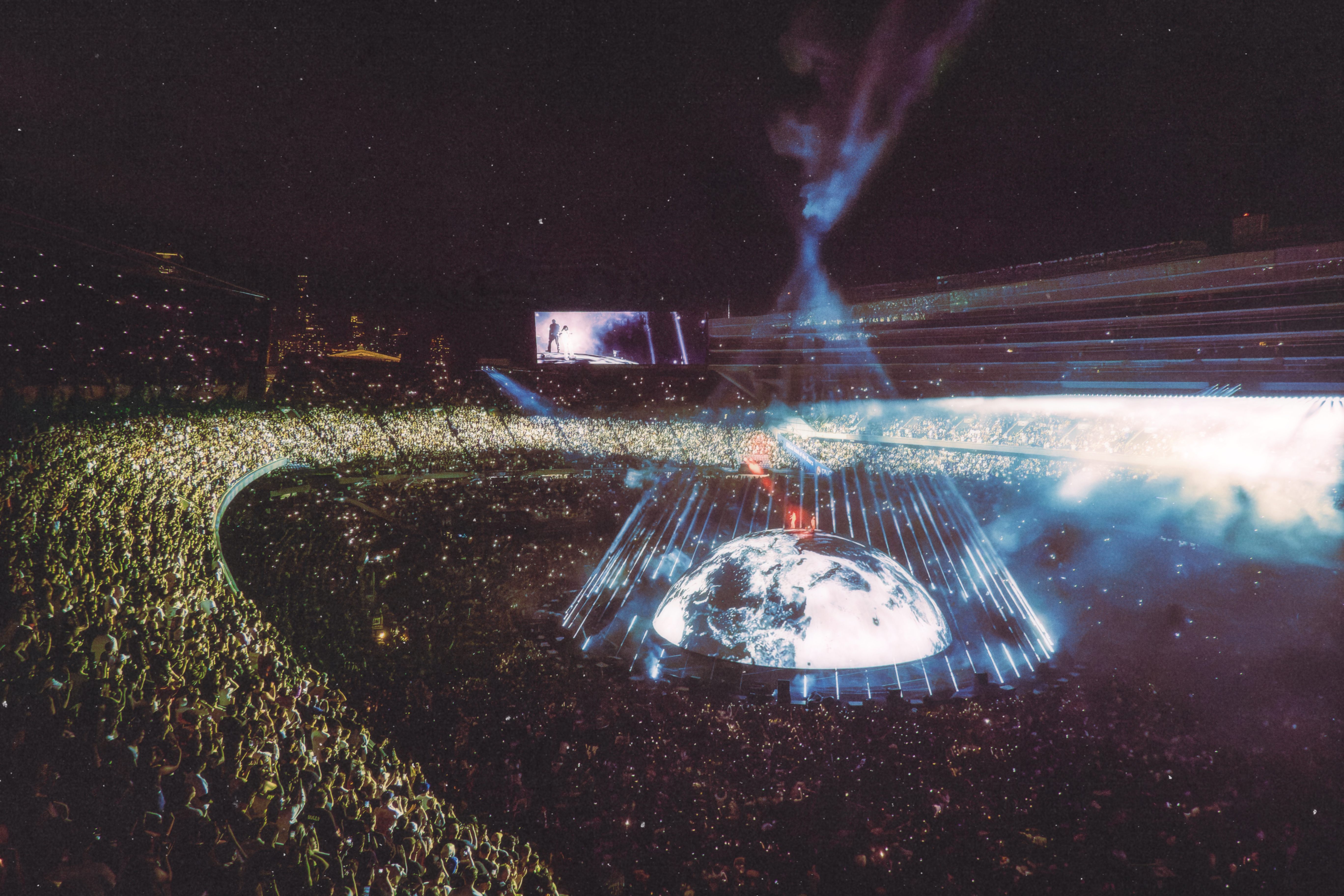
Ye returned to the city that made him. Anthony Cavale returned to the city that made his family—standing on the field at Soldier Field, camera in hand, photographing the night for Cavale Live, the independent publication he built himself.
Through my camera, Ye looked tiny—one person standing on top of the world.
Below him, the globe glowed blue. Then the pyro went off, Soldier Field turned orange, and phones rose across the crowd.
I had spent my life watching this stadium on television. Now I was on the field, photographing my favorite artist for my own publication.
September 4, 2026. A Friday night in Chicago. Night Two.
Bro. Try explaining that to the kid in the back of government class who couldn’t get TIDAL to load.
But the connection went deeper than music.
Chicago had been part of my family’s story long before Ye became part of mine. His homecoming brought me to Soldier Field. My family’s history explained why being there felt like something more.
Chicago Was Never Just a City I Liked
My great-grandfather came to America from Italy as a teenager.
The story I grew up with almost sounds like something out of The Godfather: a kid leaving his family, his friends, his language, and the only life he knew behind, coming to America essentially by himself and eventually settling in Chicago.
He built a business. He raised a family.
In his own way, he achieved the American dream.
My family eventually moved west, but Chicago never really left us. I grew up watching the Bears on Sundays, not the Cardinals. Cubs and Bears memorabilia was part of the furniture of my childhood. Those were our teams.
I know the mythology of the ’85 Bears. I know what Michael Jordan and the ’90s Bulls meant to the culture.
But I was born in 1997.
I didn’t get Michael Jordan.I got Derrick Rose.
I watched this kid from Chicago become the youngest MVP in NBA history and believed I might be getting my generation’s Bulls dynasty. Then I watched him tear his ACL.
When the Bulls gave me reasons to hope again, LeBron James kept standing at the end of the road.
My first Super Bowl experience was watching the Bears lose. I remember crying when the Packers beat us at Soldier Field in the NFC Championship Game.
I remember believing in the Cubs in 2008, then watching the Dodgers sweep them out of the NLDS.
So when one of my students finds out I’m a Bears fan and asks, almost suspiciously, “Wait, you’re actually a Bears fan?” I always give them the same answer:
“Do you think I do this to myself for fun?”
Bro, I’ve been here.
I didn’t pick Chicago because the logos looked cool.
I inherited it.
And then I chose to keep it.
But it hasn’t all been heartbreak. I got the Blackhawks’ championship years. And in 2016, I got to watch the Cubs win the World Series after 108 years.
That’s a pretty incredible payoff for spending your life emotionally attached to something that keeps disappointing you.
Looking back, I understand why that loyalty felt familiar.
For a lot of my childhood, hope arrived before evidence.
I Knew the Underdog Before I Knew What to Call It
Being an only child with divorced parents could be lonely. Growing up in special education could make me feel stupid.
I wasn’t the academic standout or the superstar athlete. I was usually the skinniest kid on whatever team I played for. There wasn’t an obvious thing I could point toward and say, That’s what makes me special.
Then I found this guy from Chicago who wouldn’t shut the fuck up about how much he believed in himself.
That’s what Kanye West’s music gave me: a language for a feeling I already had.
The feeling of being overlooked and still believing there was more in you. Of seeing the role everybody else seemed to have assigned you and thinking, No. That’s not enough.
The producer who wanted to be recognized as a rapper saw himself differently than the industry initially saw him. That story resonated with me.
Our lives weren’t comparable. But wanting an opportunity before anybody seemed ready to give you one? I understood that.
Explaining what his music has meant to me is not a defense of everything he has said or done. That connection doesn’t require anyone else to overlook those things, either.
What I carried from the music was the creative conviction: somebody else’s perception of you does not have to become your own.
For a while, that was mostly a feeling.
Then, in 2016, I began to understand what I wanted to do with it.
2016
I graduated high school that year.
One of my clearest memories from that period is sitting in the back of Ms. Hoffman’s second-period government class, paying attention to basically anything except government.
More specifically, I was trying to get Kanye West’s livestream to work.
Yeezy Season 3. Madison Square Garden. The premiere of The Life of Pablo alongside a fashion show.
For anyone who missed that era, TIDAL was the music-streaming service Jay-Z had relaunched with a group of artist-owners in 2015. For this premiere, it was the official online stream I was trying to watch—the way into the show and my first chance to hear the new album.
Those of you who remember the Kanye/TIDAL era probably already know where this is going.
It would not fucking load.
The stream was getting hammered by viewers. On my phone, all I knew was that I was trying to watch something I desperately wanted to see, and it kept failing.
So I kept switching to Twitter, checking updates and whatever clips people were posting, trying to piece the event together when the stream wouldn’t cooperate.
That’s the scene I remember: government class, my phone, and my attention somewhere inside Madison Square Garden.
The clothes, the music, the visuals, the scale—I thought it was the coolest shit on the planet.
Then I heard “Father Stretch My Hands, Pt. 1.”
The image of Ye and Kid Cudi jumping around to it stayed with me. That beat dropped, and before I’d even heard the rest of the album, I knew:
That’s my song.
Ten years later, it still is. Top three Ye for me. Easy.
But what stayed with me wasn’t only the music. Looking at everything happening together, I thought:
That’s what I want to do.
Not rap. Not become Kanye West.
I wanted to make things.
I wanted to have an idea in my head and somehow make it exist in the real world.
I didn’t know what that meant yet. I was a high school senior trying to watch a fashion show and album premiere instead of paying attention in class.
But the idea stayed.
Then came the next ten years.
The Ten Years Nobody Sees
That’s the part we compress when we tell success stories.
I started photographing concerts with an iPhone. I learned, bought equipment, found outlets, and built a portfolio. I photographed sports and music, built websites, went back to school, and started teaching.
None of it happened as neatly as that paragraph makes it sound.
There were unanswered emails. Rejections. Opportunities that went to somebody else. Long stretches of wondering whether I was getting anywhere.
I also went into creative spaces looking for friendship and community. Some felt lonelier and more competitive than I had expected. That hurt in ways I hadn’t prepared for.
Eventually, I looked at the gatekeeping around concert photography and asked myself why I was waiting for somebody else’s publication to decide whether I could do this.
So I made one.
Cavale Live.
I built the website, assembled the portfolio, researched contacts, and sent the emails. When people didn’t answer, I kept looking for another route.
Eventually, publicists responded. Managers appeared on email chains. Credentials got approved.
From the outside, that’s the part people could see.
What they couldn’t see were the family responsibilities waiting when the concert ended. Working while going to school. Ten-hour teaching days. Driving Walmart deliveries, Grubhub, or DoorDash because rent still had to be paid, but I needed enough control over my schedule to keep pursuing something with no guarantee of working.
The questions were considerably less cinematic than the photographs.
Can I afford this flight?
Can I miss this shift?
Can I make rent and still make this happen?
What if none of this works?
That’s the part of ambition nobody photographs.
There are no lights or applause. Sometimes it’s just you, exhausted, doing the math again.
I kept going—not because I knew it would work, but because I knew how much it mattered to try.
I can live with failure. I don’t think I could live with what if?
And in Cavale Live’s first year, that decision brought me to Soldier Field.
Ten Years Later
This was my fourth trip to Chicago and my first time going alone.
I flew there by myself. Moved through the city by myself. Then walked onto a field I had spent my life watching on television.
I wasn’t representing somebody else’s publication.
I was there for something I had built.
That was enough to make the trip significant. The family connection made it harder to put into words.
Generations earlier, my great-grandfather had arrived in Chicago to build a life. His decision became part of the history I grew up with. Now I was returning with a camera and a reason of my own to be there.
Chicago had always been something my family handed down.
Now I was making a memory there that I could contribute to it.
Night Two
I had already seen Ye’s second Los Angeles show. Coming to Chicago, I couldn’t help expecting something unusual.
Moving through the floor, I could hear that anticipation around me. People were talking about Travis. Cudi. Chief Keef. One pocket of people had one rumor; another had something completely different.
Everybody had information.
Nobody had information.
That was part of the fun.
I kept moving, photographing from different positions, listening, and watching people react. At one point, I was standing shoulder to shoulder with Cole Bennett.
I recognized him. I respected what he had built. And, to my surprise, I didn’t feel the need to turn the moment into anything.
I didn’t need a photograph or an introduction to make being there count.
He was there doing his thing. I was there doing mine.
For once, that didn’t feel like a comparison.
Later, I learned that Caleb Williams had attended in disguise—a mask and glasses.
The quarterback of the fucking Chicago Bears.
Of course he had. Apparently, that was the kind of night we were having.
Then the guest appearances started making the rumors feel inadequate.
Across the night, the stage welcomed Chief Keef, Big Sean, 2 Chainz, Rick Ross, Don Toliver, Travis Scott, and Young Thug. There were appearances from CyHi, Really Doe, GLC, Consequence, Twista, Common, and Lupe Fiasco.
Different eras of Ye. Different eras of Chicago. Different parts of hip-hop’s history sharing the same night.
It reminded me of Spider-Man: No Way Home. You know these people from different chapters. You’ve imagined what it would feel like if those chapters collided.
Then suddenly everybody is standing in the same universe.
Hearing Rick Ross on “Devil in a New Dress” was one of the moments that hit me hardest.
I was there to document it. I was also trying to absorb a song that had lived in my headphones for years.
And every time I thought the night had reached its peak, somebody else appeared.
That pace came with a trade-off. Songs I wanted to sit with—including “All the Love,” which could eventually become a top-five Ye song for me—barely had room to breathe before the next thing happened.
Normally, I would have cared more.
That night, the anticipation kept winning.
I didn’t get my perfect setlist. I got the feeling that I couldn’t predict what would happen next, even while I was watching it.
One Man Standing on the World
At the center of it all was the globe.
Through my camera, the curved surface, blue light, smoke, and surrounding darkness could make a performer look as though he were standing on another planet.
Sometimes the figure nearly disappeared into the scale of it. At other moments, the lighting and fire made that same person feel enormous.
That contradiction was what I kept trying to photograph.
Not simply, Here’s Kanye West.
I wanted someone who hadn’t been there to understand what the experience felt like.
So I shot wide. I photographed the globe, the fire, and the figures disappearing into Soldier Field.
Then I turned around.
People were sweating, screaming, holding up phones, and grabbing each other when they realized who had walked onto the stage. There were faces in the light, hands reaching out of the darkness, and bodies moving through the crowd.
The audience wasn’t something to crop out of the concert. It was part of the experience.
A distant photograph could show the scale of the production. A close photograph of somebody reacting could explain why that scale mattered.
I wanted both.
Then I heard “Father Stretch My Hands, Pt. 1.”
Father Stretch My Hands
Remember the kid in the back of Ms. Hoffman’s government class?
This is where he comes back into the story.
Ten years earlier, I was trying to watch that world through my phone.
Now I was holding a camera at Soldier Field.
And Kid Cudi walked out for “Father Stretch My Hands, Pt. 1.”
Bro.
What do you even do with that?
There are moments when life becomes so neatly connected that it almost feels corny. Like, come on. Who scripted this?
Earlier that year, I had seen Cudi open his Rebel Ragers Tour in Phoenix. The show ended with “Reborn,” from KIDS SEE GHOSTS, the album he made with Ye.
Now I was watching them together, performing a song I had loved from the moment I first heard it.
I could remember the excitement of watching those clips and wanting, without knowing how, to build a creative life.
For a second, I thought:
What did I do to deserve this?
That surprised me. I knew the hours and the sacrifices. I knew what it had taken to get there.
But gratitude doesn’t always operate according to what you’ve earned.
Sometimes something you’ve wanted for so long finally happens, and your first thought isn’t I deserve this.
It’s:
Holy shit. I actually get to be here.
Cudi stayed for “Ghost Town” and “Pursuit of Happiness.” I watched them embrace. What I remember most is seeing them together and, eventually, watching them walk away together.
After all the guests, the fire, and the sheer scale of the night, the feeling that stayed with me most clearly wasn’t adrenaline.
It was relief.
I don’t know either man personally. I don’t know their private relationship or what happens next. Watching them together wasn’t proof that everything had been resolved.
But it made me think about healing.
Not pretending something never broke. Not deciding that enough time automatically makes everything okay.
The possibility that what happened does not have to determine everything that happens afterward.
I had arrived expecting another extraordinary performance.
I hadn’t expected that to be the part I carried home.
Leaving the Anger Behind
I’ve carried resentment toward people who made me feel small when I was already struggling.
People ridiculed what I wore, the music I listened to, the movies I liked, and the opinions I had—pieces of who I was. For a long time, part of me wanted eventual success to become a response.
I’ll show you.
There is fuel in that. I’m not going to pretend otherwise. Anger can get you through some shit.
But fuel isn’t necessarily somewhere you want to live.
Watching Ye and Cudi together made me think about how much of my ambition was still arguing with people who weren’t even there.
I didn’t want every photograph, every credential, or every finished project to be another message to somebody who had doubted me.
I wanted to enjoy the work.
I wanted to recognize what it had taken to get there without turning that recognition into a comparison.
The concert didn’t erase every old feeling. That isn’t what I mean.
It gave me a moment in which something else felt more important.
I had work I cared about. A publication of my own. Students, family, and a life beyond whatever somebody else thought of me.
None of it made me better than anybody.
It gave me reasons to respect myself.
I didn’t want the next chapter of my life to be secretly addressed to everybody who had hurt me.
On My Own Scale
I’m still building.
I don’t know what Cavale Live will become or what my work will look like ten years from now. This trip wasn’t proof that everything would work out.
But a homecoming didn’t have to mean I was finished.
Chicago didn’t have to be where I was born for returning there to matter. My family’s history had given me a connection to the city. This time, I arrived with work of my own.
Ye had returned to the city that made him.
I had returned to the city that made my family, carrying something I had made.
That was the bridge.
And when I thought about the kid in Ms. Hoffman’s government class, what struck me wasn’t simply that I had finally gotten close enough to photograph somebody I admired.
It was that I was doing the thing that had excited me in the first place.
Making something.
Ten years earlier, I had been refreshing Twitter because TIDAL wouldn’t fucking load, watching pieces of The Life of Pablo unfold and wondering what it would take to turn an idea into something real.
Ten years later, I wasn’t watching Ye and Cudi through my phone.
I was standing on the field at Soldier Field, camera in hand, photographing them for Cavale Live.
The independent publication I built myself.
Not on Kanye West’s scale.On mine.
And for the first time, that feels like enough.
AI Editorial Disclosure: The experiences, reporting, observations, ideas and voice in this story are Anthony Cavale’s. ChatGPT was used only as an editorial assistant to help organize, structure, copyedit and refine material originally developed by Cavale. All photography and final editorial decisions are his.
Photo Gallery · 67 Images


