
Concert Review
Green Day's Saviors Tour Brought My First Concert Full Circle
Green Day · The Saviors Tour · Chase Field · Phoenix, AZ
A full-circle recap of photographing Green Day years after they became Anthony's first concert, connecting childhood memories, American Idiot, Dookie, Chase Field, and the meaning of finally shooting them credentialed.
Green Day’s Saviors Tour Brought My First Concert Full Circle
Green Day was the first concert I ever went to.
Years later, they became the first concert I ever received photo-pit credentials to cover.
There are some things in life that feel significant only after enough time has passed for you to see the line connecting them.
Standing inside Chase Field with a camera in my hands, waiting for Green Day to take the stage, was one of those moments.
Because before there was a camera, a credential, a photo pit or any idea that live music might eventually become part of my career, there was a 12-year-old kid who just really loved Green Day.
I grew up during the American Idiot era.
The black shirts.
The red ties.
The eyeliner.
The music videos.
The attitude.
Green Day felt loud, rebellious, funny and slightly dangerous in exactly the way that made perfect sense to me as a kid.
One of my favorite memories from that period happened at a childhood friend’s birthday party.
She was a girl, so the party was covered in pink decorations, Barbie-type stuff and music that was very clearly not chosen with me in mind.
Naturally, I walked up to the DJ.
“Can you play ‘Holiday’ by Green Day?”
He looked at me like I had completely misunderstood the assignment.
And to be fair, I probably had.
But that was me.
If Green Day came on, I was locked in.
Then, in 2009, I had just turned 12.
My birthday is August 20. My dad’s is August 22, so our birthdays have always existed almost on top of each other.
That year, I thought we were going downtown to eat and watch a primetime NFL game.
That was the plan.
Or at least that was what my dad wanted me to think.
While we were walking around downtown Phoenix, I noticed a huge crowd gathering outside US Airways Center.
I knew there wasn’t a basketball game happening, so I started trying to figure out why thousands of people were standing outside the arena.
I remember thinking:
What is going on?
A protest?
Some huge event?
My dad suggested we go look.
So I followed him across the street, still completely clueless.
Then I saw my uncle pull tickets out of his pocket.
My dad looked at me and basically said:
“Oh, by the way, we’re going to Green Day tonight.”
I froze.
I had just turned 12.
It was my dad’s birthday.
And somehow he had turned his own birthday into a surprise for me.
But the surprise wasn’t finished.
Growing up, my dad and I weren’t sitting courtside or buying premium seats to everything. When we went to sporting events, we were usually somewhere much closer to the top of the arena than the bottom.
So once we walked inside, I was already amazed when we reached the lower bowl.
I thought those had to be our seats.
They weren’t.
We kept walking.
And walking.
Until eventually we reached the stairs leading down to the floor.
The security guard checked our tickets.
Then my dad pointed down.
Those were our seats.
I didn’t even know that was possible.
My first concert wasn’t only Green Day.
My first concert was Green Day from the floor.
Two days after my birthday.
On my dad’s birthday.
I remember the volume more than almost anything else.
It was overwhelming.
Exciting and slightly terrifying at the same time.
I remember feeling the sound in my body and not completely understanding what was happening to me.
Then a mosh pit opened.
I had never seen anything like it.
Grown adults were crashing into each other, headbanging and throwing themselves around like giant kids on a playground.
Whenever the movement started getting too close, my dad would wrap his arms around my chest and pull me back.
Close enough that I could experience it.
Far enough away that he knew I was safe.
That night was my first real understanding of what live music could feel like.
Not just sound.
Physical energy.
A room full of strangers collectively deciding to lose their minds for a few hours.
Years later, I walked into Chase Field to photograph the same band.
This time I wasn’t 12.
My dad wasn’t holding me back from the pit.
I had two cameras hanging from me and a credential around my neck.
That was the full-circle moment before Green Day even played a note.
Months earlier, I had seen the concert advertised while attending a Diamondbacks game.
I remember looking at the promotion and thinking:
I am going to figure out how to photograph this.
By then I had been building a concert portfolio and searching for a real path into credentialed music photography.
I eventually joined Blaze Radio at Arizona State University and showed them the work I had been creating.
My first assignment for them was Green Day.
The band that had introduced me to concerts was now becoming the band that introduced me to the photo pit.
Walking through the back areas of Chase Field already felt surreal.
Then we reached the pit.
And suddenly the career milestone stopped feeling theoretical.
Green Day was about to walk onto the stage directly in front of me.
I had two cameras and immediately started overthinking everything.
Do I shoot wide?
Do I stay tight?
Where is Billie Joe going?
Where should I stand?
Then I got one of those photographer instincts that is almost impossible to explain.
Something in me kept saying:
Bro.
Stand at this corner.
Go wide.
Be ready.
So I listened.
Green Day came out.
And Billie Joe Armstrong walked directly toward me.
He stepped onto the exact corner of the stage where I had positioned myself, put his foot on a speaker and leaned over the crowd.
He was so close that I probably could have touched his shoe.
And for maybe five or ten seconds, I stopped being a photographer.
My brain just went:
Holy shit.
That’s Billie Joe Armstrong.
The same person I had watched on television as a kid.
The same voice I had asked some poor DJ to play at a Barbie birthday party.
The frontman of the first band I had ever seen live was now standing directly above my camera.
Then the photographer part of my brain came back online.
Get the shot.
That is one of the strangest things about concert photography.
You can be having one of the most surreal moments of your life and still have settings to think about.
Focus.
Framing.
Light.
Position.
You have to experience the moment and work through it simultaneously.
Our shooting window was limited, so once I snapped out of the initial shock, I locked in.
And Green Day gave us plenty to photograph.
The Saviors Tour wasn’t simply a band playing old records inside a baseball stadium.
Green Day built an entire visual world around them.
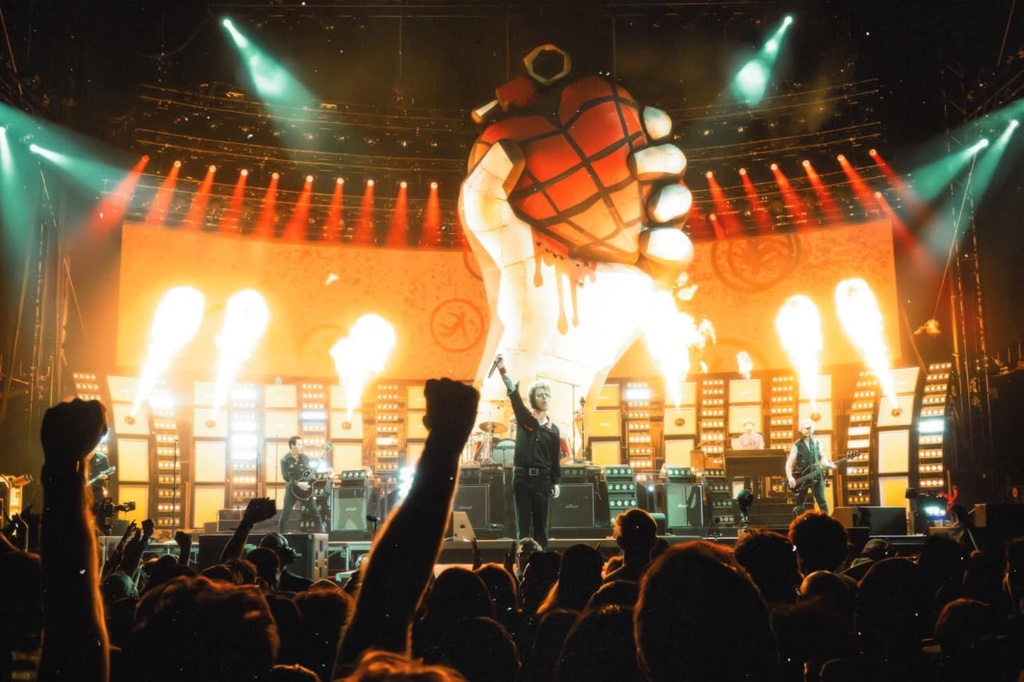
The first major section celebrated Dookie.
A giant inflatable piece inspired by the album artwork dominated the stage.
There were pyrotechnics, oversized lights and even a mocked-up airplane moving above the crowd.
The whole production looked like someone had taken the chaotic artwork and attitude surrounding Green Day and expanded it until it could fill a stadium.
It was loud.
Colorful.
Ridiculous.
Intentional.
A punk-rock cartoon universe.
That has always been one of Green Day’s strengths.
They can be political without becoming humorless.
Angry without becoming miserable.
Emotional without losing the feeling that this is still supposed to be fun.
The production understood that.
It felt like a punk-rock carnival built for a stadium.
After the photo window ended, I put my professional equipment away and went back into the crowd.
I had bought a ticket too.
I wasn’t going to photograph Green Day for three songs and leave.
I wanted the concert.
And that became important once they reached American Idiot.
I hadn’t listened to the album front-to-back in years.
I knew the obvious songs.
But I could not have sat down before the show and confidently recited the entire track list or told you I still remembered every lyric.
Then they started playing it.
And something opened.
Songs I thought I had forgotten started coming out of me almost automatically.
Lyrics surfaced before I consciously remembered knowing them.
It felt like my body remembered the record before my brain did.
That is what nostalgia can actually feel like.
Not somebody telling you:
“Remember this?”
Something buried inside you suddenly becoming present again.
For a few minutes, I wasn’t consciously thinking about being 12.
I just was.
The kid asking for “Holiday.”
The kid yelling from the backseat when Green Day came on the radio.
The kid standing on the floor at his first concert while his dad held him back from the mosh pit.
Except now I was standing inside Chase Field with years of life between those two versions of myself.
That also made the audience around me fascinating.
Green Day didn’t have one generation in that stadium.
They had several.
There were people older than my dad.
People my age.
Teenagers.
Little kids who looked younger than I had been when my dad took me to that first show.
Some people grew up with Dookie.
Some grew up with American Idiot.
Some discovered the band long after both.
And somehow they were all shouting the same songs.
You could literally see Green Day’s longevity in the crowd.
The band still understood how to make those people feel involved too.
One of the things I remembered most from seeing them as a kid was how willing they were to pull fans onto the stage.
They would find someone in the audience, ask whether they could play and suddenly some random fan was performing with Green Day.
At 12, I thought that was the coolest thing imaginable.
Years later, that instinct was still there.
Despite the stadium production, the pyro, the giant props and decades of success, Green Day still tried to collapse some of the distance between the band and the audience.
That matters.
Because nostalgia alone can fill a venue once.
It cannot explain decades of people continuing to show up.
Green Day have survived because the songs remain alive inside people, and because the band still performs them like they understand what those songs have become in other people’s lives.
I understood that differently by the end of this show.
For some people at Chase Field, Green Day represented college.
For somebody else, high school.
A first relationship.
A first album.
A first political awakening.
A first concert.
For me, it was that last one.
And now something else too.
My first credentialed photo pit.
I don't want to lose the ability to appreciate how strange that is.
Concert photography can become work.
There are call times.
Waiting.
Rules.
Emails.
Approvals.
Denials.
Equipment.
Deadlines.
Eventually, I’m sure some of that can become routine.
But I never want the routine to completely erase the part of me that still thinks:
This is fucking cool.
Because it is.
I walked into my first Green Day concert as a 12-year-old who didn’t even know floor tickets existed.
Years later, I walked into another one carrying cameras because somebody trusted me to document it.
And after the photo pit, I got to stand in the crowd again and hear an album my conscious mind had partially forgotten while some deeper part of me remembered every word.
At 12, I stood on the floor while my dad wrapped his arms around me whenever the pit got too close.
Years later, I stood in another Green Day crowd with a camera in my hands and Billie Joe Armstrong directly above me.
I couldn’t have understood it in 2009, but that first concert introduced me to a world I would eventually build part of my life around.
My dad thought he was giving me a birthday present.
He had no idea how far I was going to carry it.
AI Editorial Disclosure: The experiences, reporting, observations, ideas and voice in this story are Anthony Cavale’s. ChatGPT was used only as an editorial assistant to help organize, structure, copyedit and refine material originally developed by Cavale. All photography and final editorial decisions are his.
Photo Gallery · 18 Images


